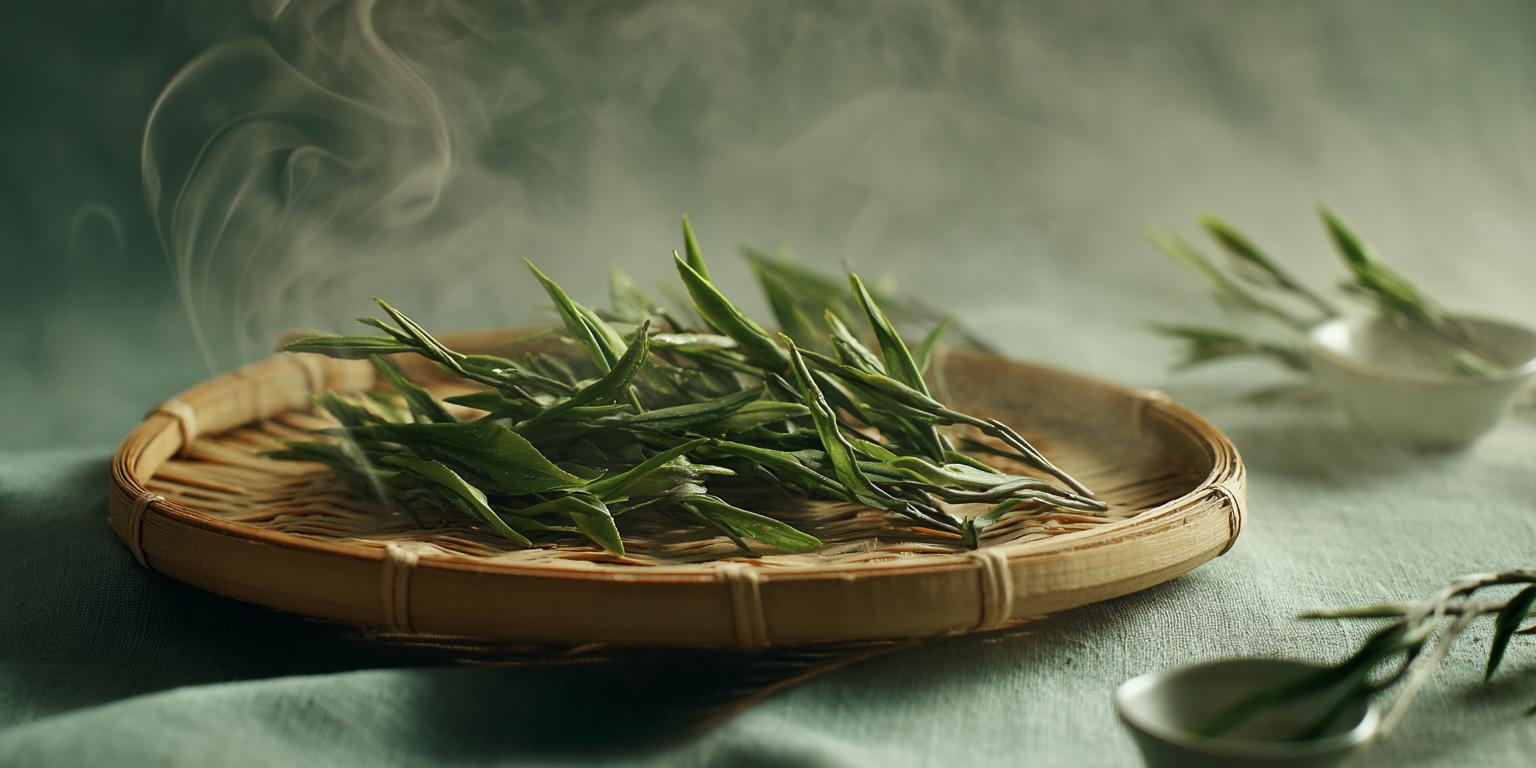
Origin as flavor
You can’t separate green tea from place. Not only the country, but also altitude, mist, soil, wind, proximity to the sea, and the exact picking time shape the leaf. In tea, people often talk about terroir, but you don’t have to remember the word: it comes down to one simple observation. A leaf doesn’t grow in a vacuum.
What the farmer can influence
- Picking moment: early pickings are often finer, softer, and more aromatic.
- Picking standard: only bud + two leaves, or coarser leaf.
- Cultivar: some varieties give more sweetness, others more green and tension.
- Shade: in certain styles, the plant is shielded from direct light for weeks, which changes the balance in the leaf.
What you taste back in your cup
- Texture: from light and sparkling to creamy and round.
- Bitterness: sharp and short, or soft and gripping.
- Aroma: fresh green, nutty, floral, seaweedy, roasted.
- Finish: clean and dry, or long and umami-like.
That’s why “green tea” is not one flavor. It’s a family of choices, from field to dried leaf.
Japanese green tea
In Japan, a lot revolves around precision: timing, steam, temperature control, rolling in multiple phases. The goal is to stabilize the leaf without losing its character. The result is often bright, intensely green, with a recognizable line of umami and a fresh, sometimes maritime note.
From leaf to sencha
- Picking (often in multiple “flushes” through the season).
- Steaming to stop the enzyme reaction.
- Cooling and drying so the leaf becomes manageable.
- Rolling in steps: the leaf is shaped and the juices are evenly distributed.
- Final drying and sorting: uniformity, breakage, color, and aroma are monitored.
Shade-growing and depth
In styles like gyokuro (and in the leaf that can later become matcha), the plant gets a period of shade before picking. That influences the leaf and often gives more softness and umami, with less rough bitterness. It’s not a “trick,” but agriculture as a flavor choice.
If you want to taste the Japanese style: Sencha Premium often shows nicely what steaming and precision do, and Sencha Gyokuro emphasizes the shade character.
Chinese green tea
In China, green tea is historically deeply intertwined with regions and crafts: each area guards its own methods, pans, temperatures, and shapes. The heat often comes more directly via pan-firing, causing aromas to shift more quickly toward warm, roasted, or chestnut-like. Many people recognize Chinese green tea by its softer, nutty finish.
What you often see in the process
- Fixation in a hot pan: brief, purposeful, with a feel for timing.
- Shaping during or after the pan: rolling, twisting, pressing, depending on the style.
- Drying until the leaf is stable, without “burning” the aroma.
- Sorting by shape and breakage: the neater the leaf, the more consistent the extraction later.
Longjing
Longjing (also known as “Dragon Well”) is often recognizable by its flat, pressed leaf and a soft, nutty signature. If you want to taste that profile at home: Lung Ching.
Mao Feng
Mao Feng is often known for its fresher, more floral side within the Chinese style, with an elegant softness. For a classic impression: Mao Feng.
A few styles you often come across
Some names refer to region, others to technique. It helps not to see them as “better” or “worse,” but as styles with their own logic.
Sencha
The everyday standard in Japan: steamed, rolled, bright. Often fresh green with tension and a clear structure.
Gyokuro
Shade-growing often brings more softness and umami. A tea that asks for calm and attention, because it quickly tastes “full.”
Matcha
Powdered tea from specially grown leaf. You drink not only the infusion, but the leaf itself in micro form. That’s why matcha feels different in texture and intensity.
Houjicha
Roasted Japanese tea (often from coarser leaf). Warm, toasty, less “green” in flavor. If you’re looking for that direction: Houjicha.
Practical rule of thumb
Steaming often points to brighter green and umami, pan-firing more often to nuttiness and warmer aromas, and roasting to toast and cocoa-like notes. They’re not laws, but they help you choose by taste.
Recognizing quality without jargon
You don’t have to be a taster to see quality. Green tea reveals a lot: in aroma, in the look of the leaf, and in how “clean” the flavor remains. If needed, take ten seconds before you brew: look, smell, feel.
What you can see in dry leaf
- Uniformity: even leaf often gives a more even cup.
- Breakage: lots of “dust” can draw hard faster.
- Aroma: fresh, alive, bright. A dull or cardboard-like smell is often a freshness signal.
What you can taste in flavor
- Bitterness that becomes sharply immediate often points to brewing too hot or less refined leaf.
- Dryness can be beautiful if it stays clean, but a roughness that “lingers” is usually too much extraction.
- Length: good green tea can linger for a long time, without becoming heavy.
And then there’s something very practical: green tea is sensitive. Freshness makes a bigger difference than many people think.
Freshness and storage
Green tea loses its fresh aromatic layer relatively quickly. That’s not dramatic, but it is noticeable: what first sparkled can become duller. The biggest enemies are simple: air, light, heat and moisture.
How to store green tea at home
- Store airtight and preferably in a dark package or tin.
- Do not put your tea next to the stove or on a sunny shelf.
- Preferably buy smaller quantities and use them up at a pleasant pace.
- Only open the aroma jar right before you scoop, and close it again immediately.
Want to go deeper on this, with practical choices for jars, bags, and stock? Keeping tea fresh is entirely about storage.
Brewing, very briefly
Most “disappointing” green tea isn’t bad tea, but brewed too hot or too long. A few small adjustments often immediately bring more softness and detail. If you like, you can find more brewing work in our general brewing guide, but below is the compact minimum.
Three rules that almost always work
- Cooler water than your intuition says, especially with fine Japanese greens.
- Steep shorter and rather pour again than one long extraction.
- Room for the leaf: a spacious filter or pot gives a more even cup.
If you want to calmly build up the whole ritual with water, temperature, and tools: The infusion ritual is a nice foundation.
Also pay attention to caffeine
Green tea generally contains caffeine. That doesn’t have to matter, but it is useful for choosing your moment. If you’re looking for something gentle for later in the evening, botanical infusions are often more obvious. We explain the difference between tea and tisane in Tisane or tea.
If you approach green tea as a craft, the cup changes by itself. You taste not only “green,” but also picking and place, heat and handling, tempo and choices. Brew calmly, taste attentively, and let one tea tell you something. That’s enough for a small ritual that lasts.