Maison Tisane
The Turnera diffusa, pure and in full growth (hero image)

Botanical cuisine

Damiana

Turnera diffusa

Why we love this botanical

Damiana opens green and resinous, with the scent of warm leaf, dry scrub and a hint of balsamic softness. In the top note a bright amber tone appears, followed by flavors of pine, hay and fine spiciness. The bitterness remains controlled, but gives direction and length. The mouthfeel is slender yet present, making this leaf feel lively and layered. Damiana has something sunny and dry-herbal, without ever becoming loud.

In tea and herbal compositions, damiana mainly provides structure. It connects fresh, green botanicals with warmer spices and prevents a blend from becoming too sweet or too flat. Its resinous, slightly vegetal profile deepens the mid-palate and lets the finish linger longer. As a result, it rarely functions as decoration, but rather as a supporting middle layer: a leaf that brings character, maintains tension, and gives other ingredients more shape.
Habitat & Origin

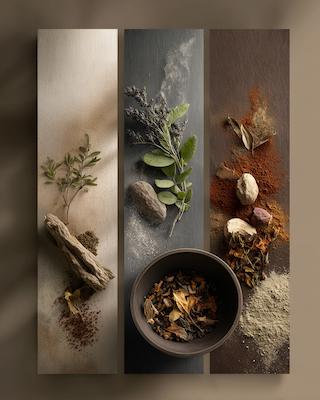
Damiana is a low-growing shrub from warm, dry landscapes mainly in Mexico, with additional distribution in parts of Central America and the Caribbean. It prefers to grow in full sun, on stony or calcareous soils and in open, dry scrub where rainfall is scarce and drainage is important. It is precisely these dry conditions that give the leaf its compact, aromatic profile. For infusions, mainly the leaves are harvested, often around flowering when aroma and flavor are most pronounced. After picking, the leaf is carefully dried so that the green, resinous and lightly spicy notes are preserved.

Active compounds

The aromatic profile of damiana mainly comes from volatile oils and other aromatic compounds in the leaf. Terpenes such as pinenes and cineole give the infusion its green, resinous and lightly balsamic note, while flavonoids and bitter constituents contribute to the dry structure and the long, herbal finish. During drying, the profile usually shifts from fresh-green to warmer and more herbal. With a long infusion, the bitters and the pine-like depth in particular become more pronounced.

Ayurvedic approach

Damiana does not belong to the classical Ayurvedic herbal tradition, but in modern, Ayurvedically inspired blends it can be read as lightly warming and aromatically drying. As a result, it is often placed more toward kapha than toward pitta, especially when a composition feels too heavy, sweet, or sluggish. For vata, damiana generally works better alongside rounder, soothing plants. In broader herbal traditions from Mexico and Central America, the leaf was valued as a fragrant daily infusion and as part of local herbal preparations.

Thermal energy (Virya) light heating

Pitta

neutral

Increasing Balancing

Effect: neutral

Vata

Balancing

Increasing Balancing

Effect: light balancing

Kapha

Balancing

Increasing Balancing

Effect: strong balancing

Dosha’s & tea
Ayurveda

Tea Blog

Dosha’s & tea

What Ayurveda understands by Vata, Pitta and Kapha — and how that provides direction for tea.

Read the article

Flavour profile & Blending

Intensity

Strong

Accessibility

Accessible

Character

vegetal, resinous, lingering, earthy, bitter

Role in the blend

Firm herb (5–10%): provides structure and body to the blend without overwhelming it.

The indicated percentage refers to the approximate weight proportion of this herb within the total blend, but it can of course be adjusted to give the herb a more dominant or more subtle role.

Damiana combines beautifully with round botanicals such as honeybush, rooibos, cocoa husk, fennel and cinnamon, which soften her bitter-green edge. With lemon verbena, rosemary or orange peel, more tension arises and a lighter top note. In blends she often fulfills the role of mid-structure or bridge: she connects green herbs with warmer notes and gives the finish more length.

An infusion of damiana pairs well with dark chocolate, orange cake, almond pastry, and roasted fruit such as pineapple or apricot. Its dry, resinous bitters counterbalance sweetness and make citrus, nuts, and caramel come through more warmly. It also works nicely with desserts with honey or lightly caramelized crusts, because it brings freshness and depth at the same time.

More flavour details

Selection guide (aroma directions)

Intensity
7
Freshness
3
Citrus
2
Fruity
1
Floral
2
Spicy / Herbal
4
Earthy / Woody
6

Food pairing (structure)

Sweetness
2
Sourness
1
Bitterness
5
Astringency
3
Body
4
Aftertaste length
6
Sharpness / Pungency
2
Blending notes: vegetal (7/10), resinous (7/10)
Flavour appreciation
Taste

Tea Blog

Flavour appreciation

Learn to taste tea mindfully — from aroma and intensity to mouthfeel and food pairing.

Read the article

Precautions

Lightly herbal and uplifting. Best avoided during pregnancy.

Experience Damiana

Discover the versatility of this botanical in our blends, or use it as the foundation for your own creation in our Blendstudio.


Contact

Reach us via chat
Chat WhatsApp
9am-6pm on working days
Reach us by email
E-mail contact@maisontisane.nl
Response usually the same working day
Reach us by phone
Call 040 – 240 5807
9am-6pm on working days

Create your own

Blendstudio Workshops

Inspiration

Botanicals Tea Blog

You can shop safely with us

You can shop safely with us (Webwinkel Keurmerk)

Pay securely with:

iDEAL VISA Mastercard American Express Riverty PayPal

Shopping Cart

( )

Your cart is empty

Total