Maison Tisane
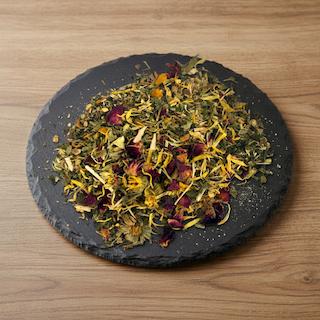
The Salix alba, pure and in full growth (hero image)

Botanical cuisine

Willow bark

Salix alba

Why we love this botanical

Willow bark produces an infusion with a deep amber color and an aroma that immediately evokes wet wood, young twigs, and a cool riverbank. In the cup you taste little sweetness; rather a dry, distinct bitterness, soft green notes, and an astringent grip that lingers for a long time. That makes its character strict but not harsh: rather calm, earthy, and thoughtful, with a bitter profile that slowly opens and leaves the mouth clean and straight.

In tea and herbal compositions, willow bark is not a decorative note, but a structuring element. It gives depth to roots, barks and spices, keeps sweeter ingredients in check and lengthens the finish without becoming heavy. Precisely because its profile is not very floral or fruity, it can let other botanicals speak more clearly. A small amount is often enough to give a blend more backbone, tension and an almost classic bitter line.

Habitat & Origin

Willow bark from the white willow, Salix alba, occurs naturally along rivers, ditches, floodplains and other moist, nutrient-rich soils in temperate regions of Europe and Western Asia. The tree prefers to grow in open places with plenty of light and a constant supply of water. For use, one usually chooses bark from young branches or prunings, because it is finer in structure than older bark. Traditionally, it is harvested in spring, when the sap flow starts and the bark comes off more easily. Drying in airy shade preserves the woody, bitter profile and helps the infusion retain its clear amber tone.

Active compounds

The character of willow bark is mainly related to salicin-related constituents, tannins and other polyphenols. That combination explains the dry bitterness, the astringent mouthfeel and the long, somewhat taut finish. In addition, flavonoids and green, slightly resinous aroma components contribute to the more vegetal and woody profile. Because the bark is compact, it calls for a hot extraction; with gentle simmering, the bitter and astringent substances dissolve out more deeply, making the infusion fuller, darker and more robust than with a short steep.

Ayurvedic approach

Willow bark originally belongs more to European and Western herbal traditions than to the classical Ayurvedic core plants. In a contemporary Ayurvedic reading, its bitter, astringent and lightly cooling nature is usually seen as suitable for Pitta and Kapha, especially when a formula needs to feel clearer, drier and less heavy. For Vata it generally calls more for being buffered with rounder ingredients, because otherwise the bark can come across as too harsh. That aligns with its historical use in austere bark and rind preparations in which bitterness was valued primarily as an ordering element.

Thermal energy (Virya) light cooling

Pitta

Balancing

Increasing Balancing

Effect: strong balancing

Vata

Increasing

Increasing Balancing

Effect: light increasing

Kapha

Balancing

Increasing Balancing

Effect: strong balancing

Dosha’s & tea
Ayurveda

Tea Blog

Dosha’s & tea

What Ayurveda understands by Vata, Pitta and Kapha — and how that provides direction for tea.

Read the article

Flavour profile & Blending

Intensity

Strong

Accessibility

Accessible

Character

earthy, lingering, astringent, bitter

Role in the blend

Very strong herb (1–2.5%): only small amounts are needed, as the herb can quickly become overpowering.

The indicated percentage refers to the approximate weight proportion of this herb within the total blend, but it can of course be adjusted to give the herb a more dominant or more subtle role.

In blends, willow bark works best as a structure builder and bitter backbone. It pairs well with licorice or cacao husks for roundness, with ginger and cinnamon for warm tension, and with orange or lemon peel for a fresher top line. Alongside piney, rooty, or herbal botanicals, it mainly brings grip, length, and a dry finish. Use it more as an accent or bridge than as a soft base.

An infusion of willow bark pairs beautifully with dark chocolate, spiced cake, roasted nuts and desserts of baked apple or pear. The dry bitterness balances sweet, buttery flavors, while the woody profile matches well with caramel, cocoa and warm spices. It also works surprisingly refined alongside more savory dishes with mushroom, roasted onion or grains, where that earthy tension comes through.

More flavour details

Selection guide (aroma directions)

Intensity
6
Freshness
0
Citrus
0
Fruity
0
Floral
0
Spicy / Herbal
1
Earthy / Woody
8

Food pairing (structure)

Sweetness
1
Sourness
1
Bitterness
7
Astringency
7
Body
4
Aftertaste length
7
Sharpness / Pungency
0
Blending notes: vegetal (3/10)
Flavour appreciation
Taste

Tea Blog

Flavour appreciation

Learn to taste tea mindfully — from aroma and intensity to mouthfeel and food pairing.

Read the article

Precautions

Naturally contains salicylates. Best avoided if you use aspirin or are sensitive to it.

Experience Willow bark

Discover the versatility of this botanical in our blends, or use it as the foundation for your own creation in our Blendstudio.


Contact

Reach us via chat
Chat WhatsApp
9am-6pm on working days
Reach us by email
E-mail contact@maisontisane.nl
Response usually the same working day
Reach us by phone
Call 040 – 240 5807
9am-6pm on working days

Create your own

Blendstudio Workshops

Inspiration

Botanicals Tea Blog

You can shop safely with us

You can shop safely with us (Webwinkel Keurmerk)

Pay securely with:

iDEAL VISA Mastercard American Express Riverty PayPal

Shopping Cart

( )

Your cart is empty

Total