Yunnan: origin is not a detail
Yunnan is mountainous, warm, and often misty. Tea gardens there sit at elevations with large day–night differences, which makes leaves grow more slowly. In many pu-erh areas, forest, agriculture, and tea trees blend into one another. That creates diversity: different plants around the garden, different soils, different microflora. In pu-erh you taste that as layering, bitterness that stays tidy, and a finish that keeps going.
With pu-erh, origin often goes even more specific than “Yunnan”: prefecture, mountain, sometimes even village or garden. So a name on a label isn’t just decoration, but a first hint at style and expectation. Once you’ve tasted one origin, comparing suddenly becomes simple (and fun).
What terroir can do
- Aroma: from floral and fruity notes to spicy, woody, or smoky.
- Structure: light and clear versus thicker, “fuller” mouthfeel.
- Bitter and sweet: some pu-erh has more bite, others more softness; often with a sweet return in the finish.
- Length: how long the flavor remains after you swallow.
Reading a label without stress
- Type: sheng or shou.
- Year: harvest year (or pressing year).
- Origin: region, mountain, village.
- Form: cake/brick/tuocha and weight.
- Maker: producer or factory (if mentioned).
Want a concrete reference point with clear origin? Then it helps to start with a pu-erh that names its origin, such as Pu-Erh Mannong.
Mini-ritual: break and smell
- Break off a small piece of the cake (gently, without crumbling).
- Put it briefly in an empty, warm cup and cover it for 10 seconds with your palm.
- Smell. You’ll immediately notice whether the profile leans toward wood, earth, flowers, or fruit. This moment often already sets your expectation for the first sip.
From leaf to maocha: the basis for aging
For pu-erh, everything starts with maocha: the loose base tea that is later pressed (sheng) or gets additional processing (shou). The process resembles green tea, but with one important difference: pu-erh is often sun-dried (shai qing). That keeps the leaf stable enough to store, but “open” enough to age later.
The classic steps
- Picking: usually young leaf (bud + leaves), depending on style and garden.
- Withering: the leaf loses moisture and becomes supple.
- Shaqing (kill-green): heating slows enzymatic oxidation; this is precision work.
- Rolling: the leaf is shaped and lightly bruised, so flavors release well later.
- Sun drying: slow drying in the sun lays the foundation for storage quality and aging potential.
Why sun drying is so important
Sun drying isn’t romance; it’s a technique. It often gives a different kind of “openness” than hot-air-dried tea. In pu-erh, that carries through into how the tea behaves later: how it evolves, how it rounds out, and how long it stays interesting. Good pu-erh therefore feels less like a finished product, and more like a tea form with a future.
Sheng and shou: natural aging and wo dui
From maocha, pu-erh splits roughly into two routes. Sheng is the traditional path: the tea is pressed and ages slowly, year after year. Shou is a more modern path (developed in the 1970s) to get a riper, darker profile faster via a controlled fermentation: wo dui.
Sheng: slow and transparent
- Often lighter in color in the cup, especially when young.
- More tension: bitter, floral, mineral, or fruity (depending on origin).
- Ages steadily and can become softer and more complex over the years.
- Lends itself well to comparing by region and harvest year.
Shou: controlled and dark
- Darker, rounder, often immediately approachable.
- Earthy, woody notes, sometimes leaning toward cocoa or dried fruit.
- Created through wo dui (pile fermentation) and then resting.
- More consistent within a batch, less dependent on long aging.
Wo dui in practice
In wo dui, maocha is piled under controlled conditions, moistened, and turned regularly. Heat and moisture steer the process; craftsmanship lies in timing, hygiene, and ventilation. A young shou can still have a “wet pile” note right after production. With rest and good storage, that usually becomes cleaner and rounder. That’s why it pays not to judge shou too hastily.
Pressing and storing: why pu-erh isn’t just loose tea
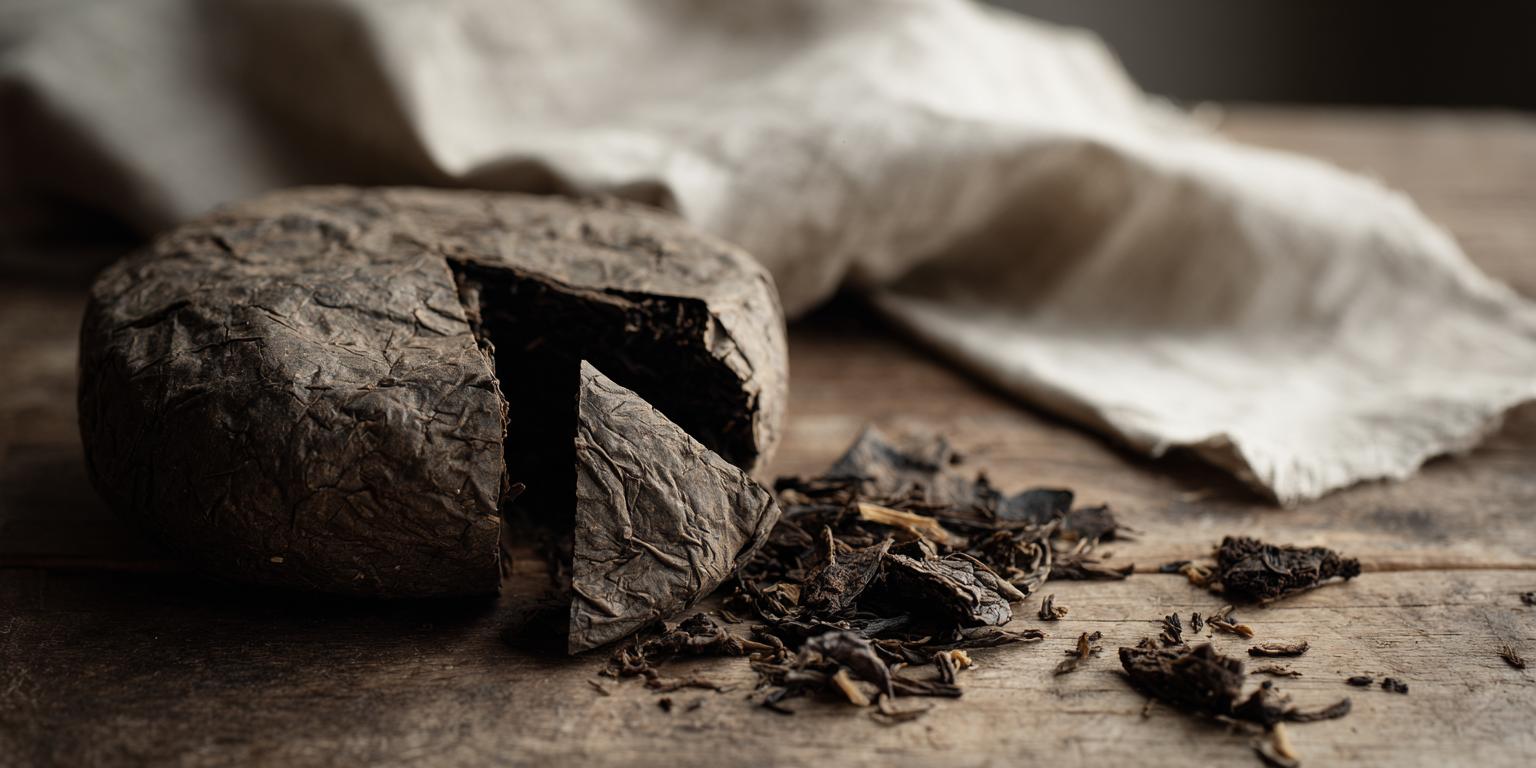
Pu-erh was historically pressed because it was convenient for transport and trade. But pressing also does something to development: it slows aging and makes it more even. A cake ages from the outside in; that creates nuance and tension. It’s one of the reasons pu-erh is so beautiful to follow over time.
At home, that means: pu-erh asks for a place with calm. Don’t seal it away airtight, but also don’t leave it open next to coffee, spices, or perfume. Tea absorbs odors easily, and pu-erh is extra sensitive in that regard.
Forms you often see
- Cake (bing): round and flat, the classic form.
- Brick (zhuan): rectangular, firmly pressed.
- Tuocha: nest-shaped, compact.
- Loose: sometimes sold as maocha or as loose shou.
Storing with care
- Preferably store in the original paper or in breathable material (no plastic bag).
- Choose a place with a stable temperature, out of direct sunlight.
- Keep away from kitchen odors (spice cabinet, coffee, onion, cleaning products).
- Give multiple cakes space rather than stacking everything tightly on top of each other.
More general storage tips (also for loose tea and botanicals) can be found in Keeping tea fresh.
Tasting without jargon: how to recognize quality
Pu-erh is sometimes surrounded by a lot of language: mountains, recipes, vintages, factories. That can be fascinating, but you don’t have to start there. You recognize quality mainly by clarity (no musty off-flavors), balance (bitterness stays tidy), and structure (a mouthfeel that carries).
Tasting ritual in 4 steps
- Look: how clean is the leaf? Do you see a lot of “dust,” or rather nice fragments and whole pieces?
- Smell: dry leaf, and then the warm leaf after the first infusion. That difference tells you a lot.
- Taste: pay attention to bitter/sweet, mouthfeel, and finish. Taste the first and the third infusion consciously: that’s often where the story is.
- Write it down: three words are enough. That way you build a foothold without it becoming a project.
Brewing in 3 lines
Want to keep it simple, without losing yourself in technique?
- Use hot water (close to boiling) and start with short infusions.
- Many pu-erh teas can be poured multiple times; each round shows a different layer.
- Want more basics about water, rest, and consistency? Our brewing guide will get you started quickly.
And if you’re curious why pu-erh almost always comes into its own better with loose leaves (or pressed pieces) than in a bag: Loose tea or bags.
Pu-erh doesn’t ask for haste. Break off a piece, smell for a moment, pour calmly, taste two rounds. If you remember one thing, let it be this: the finest pu-erh is rarely “spectacular” in volume, but almost always precise in detail.