Maison Tisane
Gong Fu Cha tea ritual (hero image)

Gong Fu Cha tea ritual

The Chinese way of brewing tea in small infusions — with aroma, calm, and precision.

The Gong Fu Cha method: Chinese tea in short infusions

The Gong Fu Cha method is a Chinese brewing style in which you use a small pot (often Yixing clay) or a gaiwan to make multiple short infusions. This way you taste how the same leaves unfold layer by layer: first aroma, then body, then a gentle finish. Here you’ll learn which parts of the tea table are functional (from fairness pitcher to strainer) and how to adjust the timing for oolong, pu-erh, or green tea. At Maison Tisane, we like to keep it clear: attention as technique, not as a show.

Gong Fu Cha may seem complicated because there are many small objects on the table, but it all comes down to one principle: always pour out completely, so the leaves don’t keep steeping. The biggest pitfalls are boiling water, too much leaf in a pot that’s too large, and pauses between infusions (then the cup quickly turns bitter). With a small volume, a calm pour, and a fairness pitcher (the jug you use to distribute), everyone gets the same taste. And with the duo of aroma cup and tasting cup, aroma suddenly takes center stage.

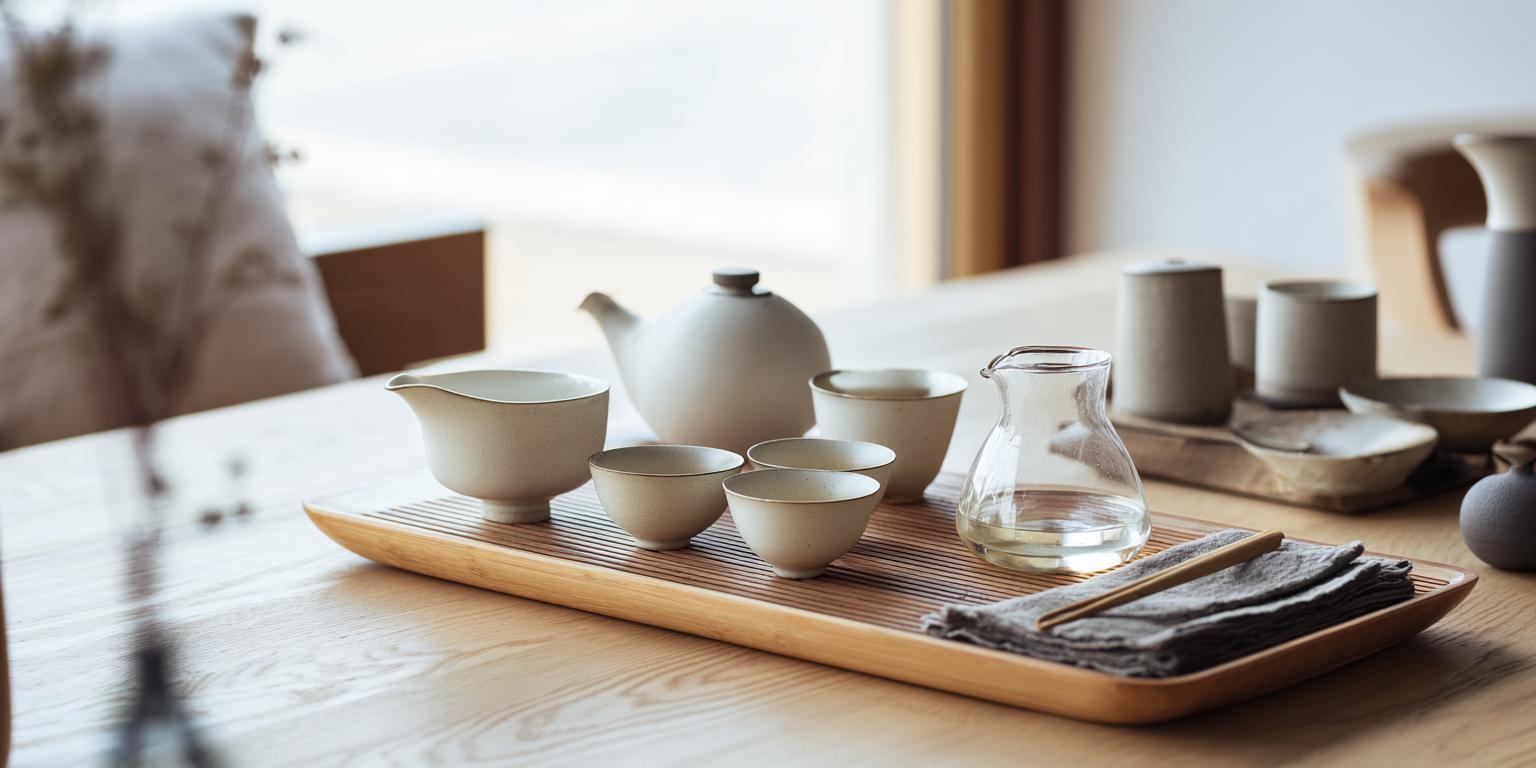
Set everything out on a tea tray, warm your cups, and before the first sip, take a moment to smell. From there, the rhythm does the rest: pour, share, taste — without haste.

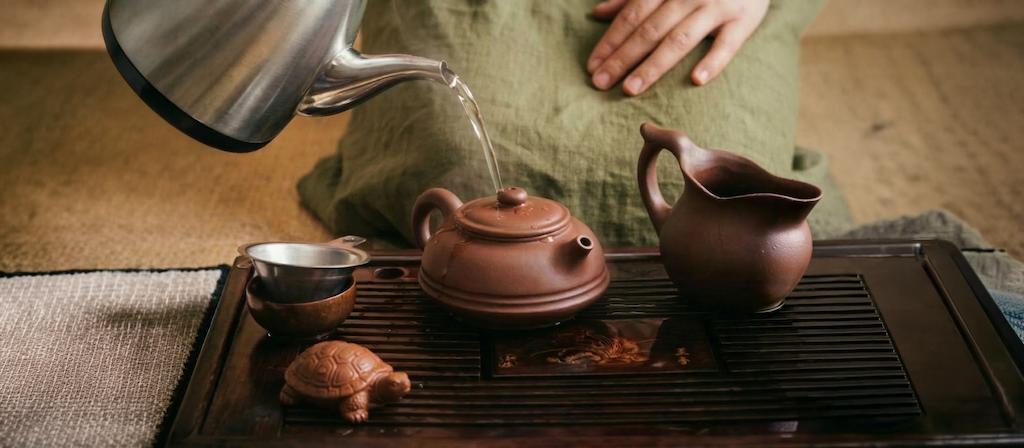
Hot water is poured in a circular motion into and over a gaiwan or Yixing teapot to warm the teaware, after which the water from the pot is poured into a fairness pitcher.

Gong Fu Cha at its core

Gong Fu Cha (功夫茶) literally means brewing tea with attention and skill. You work with a small gaiwan or Yixing pot, use relatively a lot of leaf, and make short, repeated infusions. This way you taste how a tea develops round after round.

1) Small volume

A gaiwan or small pot of 80–120 ml gives you control over timing, temperature, and extraction.

2) Lots of leaf

You use relatively a lot of leaf per millilitre, so short infusions still deliver a full flavour.

3) Short infusions

Each infusion is brief and poured out completely. This is how the tea develops round after round.

The most important principle: pour out completely

In Gong Fu Cha, no tea is left behind in the pot. This prevents the leaves from continuing to steep unnoticed and ensures each infusion keeps its own distinct strength and flavour. That’s why you pour out fully each time, preferably first into a fairness pitcher and from there into the cups.
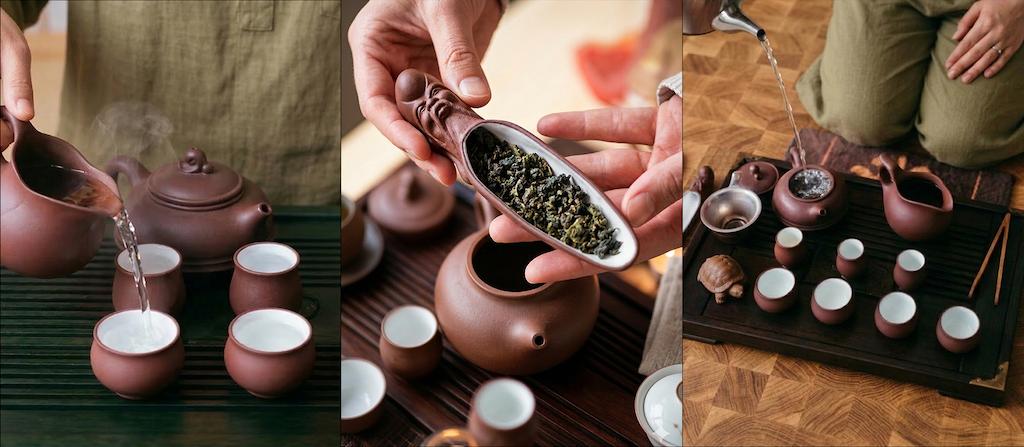
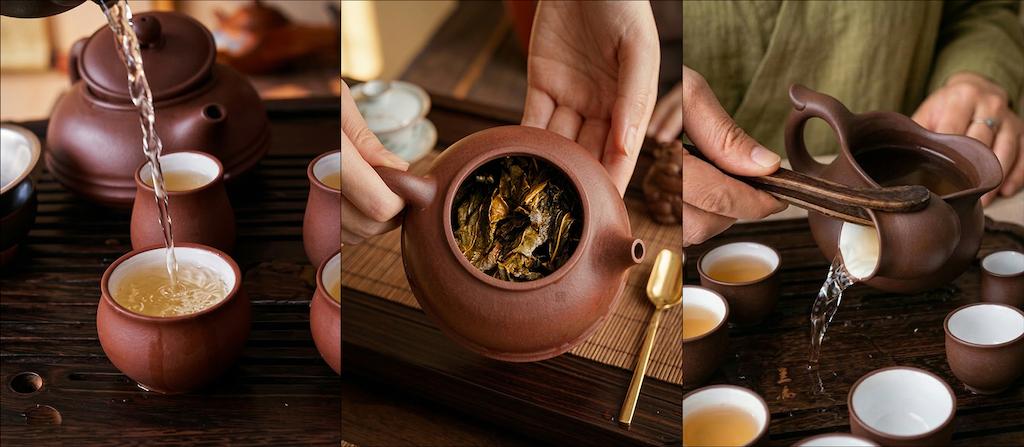
Warm water is poured from a fairness pitcher into small tasting cups to warm them, then loose tea leaves are placed into a gaiwan or Yixing teapot using a scoop and funnel, after which hot water is poured into the pot from above until it slightly overflows.

Which tea does this work best for?

Gong Fu Cha is traditionally used for oolong and pu-erh. These teas have structure and can handle multiple short infusions. The method is intended for tea from the Camellia sinensis plant. For herbs and botanicals, a longer, calmer infusion ritual usually works better; see How do you brew herbal tea? and Tisane or tea?.
The set-up: minimal, yet complete

A Gong Fu Cha set-up can look elaborate, but the basics are simple: a gaiwan or Yixing pot as the brewing vessel, a fairness pitcher to distribute the infusion evenly, and small cups to taste each round. Around that, you use a few practical tools for dosing, pouring, and handling hot water.

Essential

  • Gaiwan (盖碗) or Yixing teapot of about 80–120 ml: a small brewing vessel for short, repeated infusions.
  • Fairness pitcher (gong dao bei / cha hai): a sharing pitcher you pour the infusion into first so all cups get the same strength.
  • Tasting cups: small cups to taste the tea round by round.
  • Waste bowl: bowl for hot water, rinse water, and rinse infusions.
  • Tea towel: for drips, wet bases, and drying teaware.

Practical and traditional

  • Tea tray (cha pan): tray that catches excess water during rinsing, preheating, and pouring.
  • Tea scoop: to measure the leaf.
  • Wooden funnel: helps guide loose leaves neatly into the gaiwan or Yixing pot.
  • Tea strainer: optional, to catch small leaf bits while pouring.
  • Tongs: to move or empty hot cups without handling them directly.
  • Tea pick: a small pick to clear a spout or loosen compressed leaf.
  • Nosing cups (wen xiang bei): narrow aroma cups you smell from before tasting.
  • Tea pet: a small clay figurine that sits on the tea tray. During a session it’s often poured over with rinse water or tea as part of the ritual.
The first quick rinse of oolong or pu-erh is poured from the gaiwan or Yixing teapot into a fairness pitcher and then discarded into a waste bowl, after which the pot is refilled for the first infusion and the warm water from the tasting cups is poured into the waste bowl.

A practical Gong Fu Cha method for home

See this as a practical foundation you can vary later. The classic order is: preheat, add the leaf, optionally rinse, and then multiple short infusions that you pour out completely each time. The emphasis is on control and repetition, not speed.

Dosage

1 g per 15–20 ml (at 100 ml: 5–7 g)

Water

Oolong/pu-erh: 95–100 °C
Black: 90–95 °C
White/green: 80–90 °C

Time

Start 10–15 sec, then per round +5–10 sec

Rhythm

Preheat, pour out completely, short rounds

Step by step

  1. Preheat the brewing vessel. Pour hot water into and over the gaiwan or Yixing pot in a circular motion. Then pour this water out of the pot into the fairness pitcher.
  2. Warm the cups. Pour the warm water from the fairness pitcher into the tasting cups with a gentle back-and-forth motion so all cups warm evenly. For now, leave the water in the cups.
  3. Measure the leaf. Use a scoop to measure the tea and, with the help of a funnel, add the leaf to the gaiwan or Yixing pot. Then gently shake the pot so the dry leaves loosen and release their aroma.
  4. Fill the pot. Pour hot water from slightly higher into the gaiwan or Yixing pot until it is completely full and slightly overflows. Replace the lid with a small, circular sliding motion.
  5. Optional: rinse. With many oolongs and pu-erh, the first infusion is poured off immediately. Pour the tea first into the fairness pitcher and then into the waste bowl. This short rinse opens the leaves, warms the teaware, and removes any dust from the leaf. In many sessions, some of this water is also poured over the tea pet.
  6. First true infusion. Refill the gaiwan or Yixing pot with hot water until it slightly overflows. Replace the lid as before. With a Yixing pot, a little hot water is often poured over the outside as well to keep the pot warm. Let the tea steep for about 10 seconds.
  7. Empty the cups. Use tongs to remove the warm water from the tasting cups and pour it into the waste bowl.
  8. Pour into the fairness pitcher. If needed, first dry the underside of the gaiwan or Yixing pot with a soft cloth, then pour the tea out completely into the fairness pitcher, optionally through a tea strainer to catch small leaf bits.
  9. Divide among the cups. Pour from the fairness pitcher into the tasting cups with an even back-and-forth motion so all cups get the same strength.
  10. Smell and taste. First smell above the cup to notice the aroma. Then take a small sip and pay attention to flavour, texture, and finish.
  11. Continue with the next rounds. Start the second infusion and increase the steeping time per round by about 5–10 seconds.
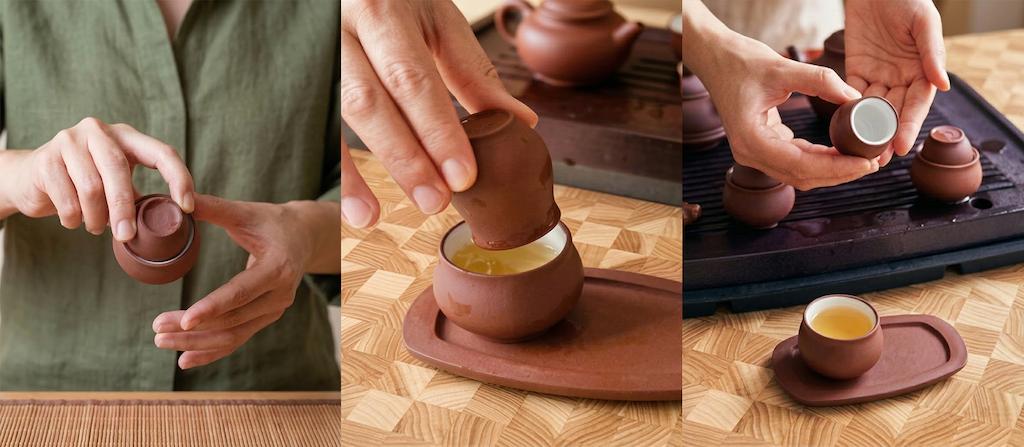
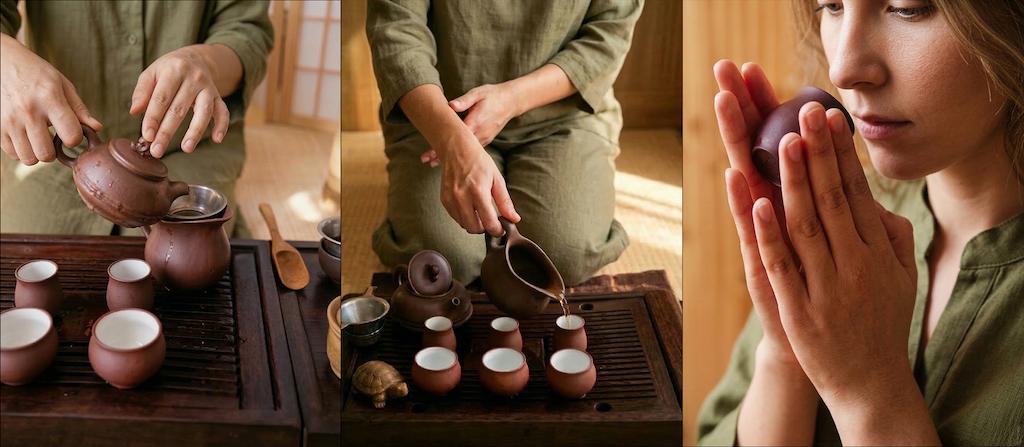
The brewed tea is fully poured from the gaiwan or Yixing teapot into a fairness pitcher, then evenly distributed among small tasting cups, after which the drinker first smells the aroma and then takes a small sip to evaluate the taste.

Tasting by round: aroma, texture, stillness

Gong Fu Cha is not only a way of brewing, but also of tasting. With short, repeated infusions, you can follow how a tea develops. An oolong may start with floral notes and later show more honey or wood; pu-erh can shift from earthy to sweeter and riper.

If you have aroma cups

First pour into the nosing cup (wen xiang bei), place the tasting cup on top, and flip both together. Then smell the empty, still-warm nosing cup; porcelain holds aromas well. Then drink from the tasting cup.

If you only have small cups

Then work with three simple steps: look (colour), smell (above the cup), and taste (a small sip). If you like, you can note down one word per round to recognise differences between infusions more easily.

A tea drinker brings a small tasting cup with freshly brewed tea close to the nose and gently inhales to perceive the tea’s aromas before tasting it.

Want to taste more intentionally?

Then use a simple framework: aroma (what do you smell?), mouthfeel (light, creamy, dry?), and finish (short, long, sweet, mineral). We’ve developed this further in Tea flavour evaluation.

Tea that works beautifully in Gong Fu Cha

Ideally, choose a tea with structure and depth that can carry multiple infusions. Because you use relatively a lot of leaf per millilitre, freshness and storage play an important role. You’ll find practical tips in Storing tea.

Oolong: from floral to roasted

Oolong is one of the most commonly used tea types for Gong Fu Cha. The leaves open gradually and reveal different aromas with each infusion.

Pu-erh: depth and long sessions

Pu-erh tolerates hot water and many short infusions. A quick rinse is common to open the leaves. During a session, the flavour can shift from earthy and mineral to sweeter and woody.

White and black: subtle or full

White tea calls for a slightly lower temperature and slightly longer first rounds. Black tea, on the other hand, can work beautifully with compact, short infusions if you want to avoid bitterness.

Green: possible, but with finesse

Green tea can be brewed in a gaiwan, but it calls for softer water, a lower temperature, and less aggressive timing. If you’re new to Gong Fu Cha, oolong is usually more forgiving.

Troubleshooting: small adjustments, big impact

Gong Fu Cha is sensitive to details, but that’s exactly what makes it nice: you never have to change everything at once. Adjust one variable and taste the difference. These are the quickest, calm fixes.

Bitter or sharp

  • Shorten the round by 3–5 sec.
  • Lower the water temperature (e.g. 95 to 90 °C).
  • Pour out faster and completely (don’t “let it sit”).

Too light or watery

  • Use a bit more leaf (0.5–1 g extra).
  • Lengthen the round by 5 sec.
  • Preheat your cups and pot better.

Aroma is flat

  • Use fresher water and start hot (especially with oolong).
  • Keep the lid on between pours.
  • Use a fairness pitcher: blending makes the cup feel “more complete”.

It turns into a mess

  • Set out a waste bowl and accept a little spilling.
  • Use a tea towel as a work surface if you don’t have a tray.
  • A small strainer over your fairness pitcher keeps things tidy.

Remember: the method is precise, but not strict. You’re not “performing” anything. You’re making space to taste.

Gong Fu Cha is, in the end, a gentle ritual of repetition: warm teaware, short rounds, small sips. If after three infusions you’re already breathing more calmly, the method has succeeded. Not because it was impressive, but because you were truly present for a moment.

Contact

Reach us via chat
Chat WhatsApp
9am-6pm on working days
Reach us by email
E-mail contact@maisontisane.nl
Response usually the same working day
Reach us by phone
Call 040 – 240 5807
9am-6pm on working days

Create your own

Blendstudio Workshops

Inspiration

Botanicals Tea Blog

You can shop safely with us

You can shop safely with us (Webwinkel Keurmerk)

Pay securely with:

iDEAL VISA Mastercard American Express Riverty PayPal

Shopping Cart

( )

Your cart is empty

Total