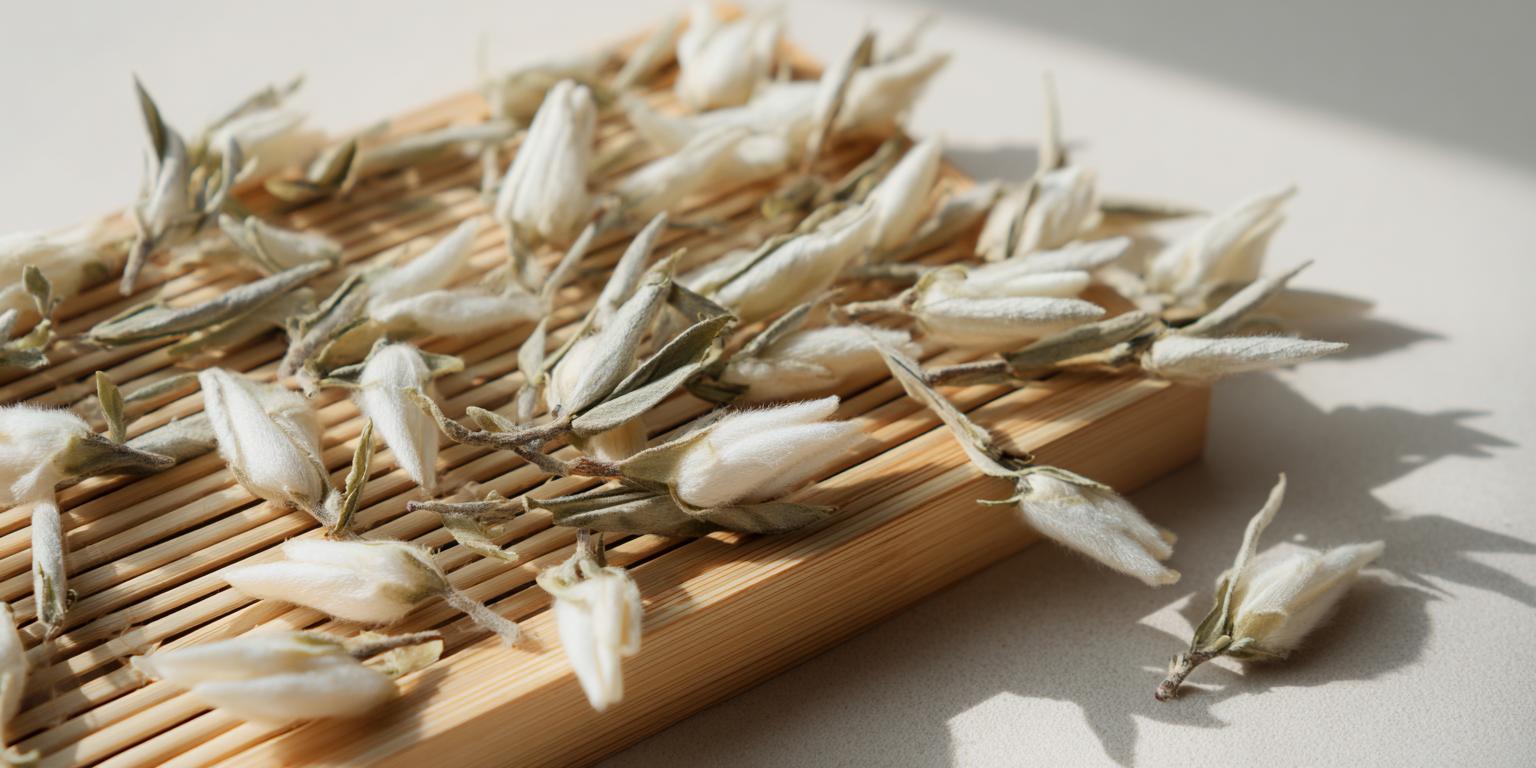
Origin: Fujian as the classic birthplace
If you want to understand white tea, you start in Fujian (China). A coastal province with mountains, mist, and a climate in which young shoots can develop slowly. That slow growth is important: buds stay compact, aromatic, and delicate. White tea is not “made” through many actions, but through carefully not doing too much.
Within Fujian, two names are often mentioned: Fuding and Zhenghe. Think of them as two families within the same story. Not as rules, but as direction: each garden, altitude, cultivar, and harvest day colors the final cup.
Fuding: bright and floral
Fuding white tea is often associated with a light, bright style: floral notes, gentle sweetness, and a clean finish. The picking is often fine and the grading strict, allowing the tea to remain transparent and elegant.
Zhenghe: a bit fuller and rounder
Zhenghe is known in many descriptions for a slightly richer body: more depth, sometimes a bit fruitier, with a rounder structure. Especially with pickings that include more leaf, that character can come through beautifully.
The best thing about white tea is that “origin” is not just a place name. You also taste it in the pace of growth, the humidity during withering, and in how carefully the picking was handled.
Production: wither, dry, force nothing
White tea has a reputation for being “minimally processed,” but that is exactly why production is so precise. Because you correct little with heat or rolling, the basics must be right: picking moment, leaf quality, ventilation, moisture, timing. A small mistake will later show up as roughness, dullness, or a flat cup.
The process in five calm steps
- Picking: young buds (and sometimes the first leaves) are hand-picked, often in early spring.
- Sorting: damaged leaf and coarse parts are removed. White tea likes intact material.
- Withering: the leaves are spread out and slowly lose moisture. Much of the aroma develops here.
- Light drying: sun, warm air, or gentle oven heat brings the tea to a stable moisture level.
- Rest and selection: after drying, it is selected again and sorted by grade.
Where the craft really lies
- No bruising: white tea doesn’t bustle with handling, so damage more quickly creates a harsh edge.
- Withering with air: too little air makes it dull; too much heat makes it flat. The maker steers with ventilation and time.
- Drying without “cooking”: the goal is stability, not a roasted taste. Gentle drying preserves nuance.
If you like tasting with attention, it helps to see white tea as a recording of one short period in the year. A few days of picking. A few days of processing. After that: silence in the leaf.
Styles and names: what you see already tells you a lot
Within white tea, names often say something very concrete: which parts were picked and how strictly they were selected. Bud-only is usually rarer and more delicate; bud with leaf often gives a bit more body and a broader arc of flavor.
Silver Needle (Bai Hao Yin Zhen)
Almost exclusively buds. Fine, light, often very clean and floral. This is white tea in high definition: small detail, great silence.
In our collection you’ll find, for example, Jasmin Silverneedle, where the character of the bud is carried by floral fragrance.
White Peony (Bai Mu Dan)
Usually bud plus young leaves. Still elegant, but with a bit more structure and roundness. This is often the style people “get to know” as white tea.
A fine example is Bai Mu Dan White tea from Fujian.
Gong Mei and Shou Mei
Pickings with more leaf and a more robust profile. Often a bit fuller, sometimes lightly fruity, with a warmer undertone. These are also styles that can age beautifully.
Aged white tea
Some white tea is deliberately kept older (sometimes even pressed). The cup can then become deeper and rounder, with less “top” and more layering.
Want to sharpen your tasting words without making it complicated? Our guide to flavor evaluation helps you recognize aroma, body, and finish more clearly, even with subtle tea types like white tea.
Jasmine: scenting with flowers, not with flavoring
Some white tea is traditionally scented with flowers. With jasmine, the classic method is not about “adding a flavor,” but about letting the leaf breathe alongside fresh blossoms. At night, when the flowers open, tea is layered with jasmine. The flowers are then removed. This can be repeated for multiple rounds, until the scent has been absorbed into the leaf.
Why this can be so beautiful with white tea
White tea is naturally soft and transparent. That allows jasmine flower to add an extra layer without drowning out the base. You smell the flower first, but if the quality is good, there is still “tea” present underneath: leaf, sap, light sweetness.
Aging and storage: subtle leaf calls for protection
Because white tea is minimally processed, it is also sensitive to its environment. Odors, light, and moisture determine how long the leaf stays lively. Some enthusiasts choose aging; others want to preserve the fresh, floral top layer for as long as possible. In both cases, the same basic rule applies: protect the leaf.
For fresh white tea
- Store dark and cool.
- Keep it away from coffee, herbs, and spices: white tea absorbs odors easily.
- Seal well, but prevent “cupboard smell” by using clean materials.
For tea that may age
- A stable place, no fluctuating heat.
- No perfumes or kitchen odors nearby.
- Patience: aging is slow and varies by style and picking.
Practical storage, with a few clear choices: we’ve worked that out in more detail in keeping tea fresh and storing it.
Recognizing quality without a guidebook
White tea doesn’t have to be mysterious. You can already see and smell a lot before water even comes into play. This small check helps you recognize quality, care, and freshness better.
The quick check
- Look: are buds and leaves largely whole, with little dust?
- Smell: is the aroma clear (floral, soft, honey-like) and not musty or “cupboardy”?
- Feel: does the leaf break immediately into crumbs, or does it still feel springy?
- Ask about origin: region, picking (bud-only or with leaf), and batch info inspire confidence without big words.
Loose leaf makes the difference
White tea is, par excellence, a tea where whole leaf pays off: less dust, more nuance, less harshness. If you want to dive deeper into that difference, read loose tea versus bags.
A good start with white tea is not technique, but attention: take ten seconds with the dry leaf. Look at the buds, smell calmly, and realize that this material has seen a short season, and many hands. That awareness doesn’t make the cup “better,” but it does make it more meaningful. And that is exactly the luxury that suits white tea.