Maison Tisane
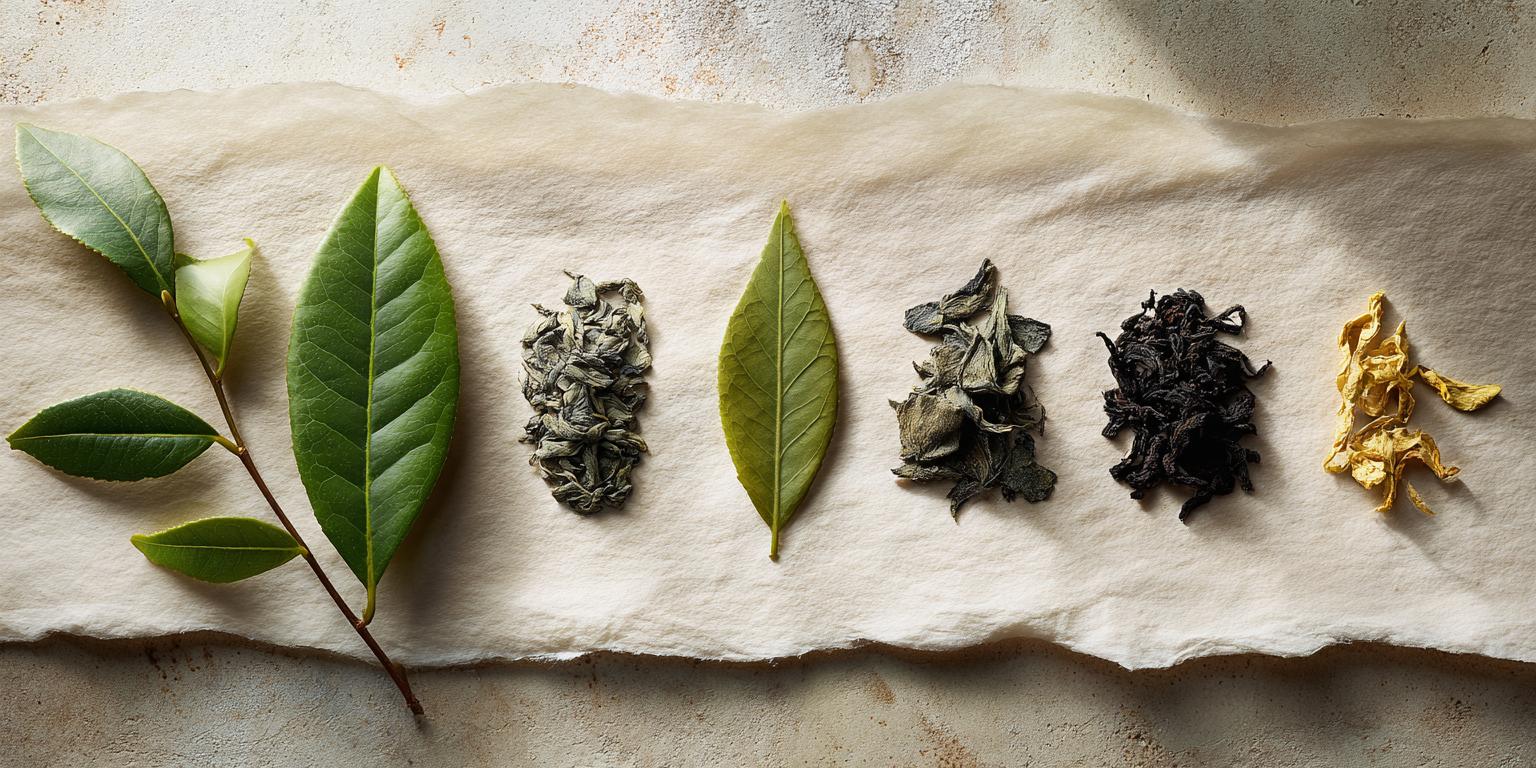
From leaf to cup (hero image)

From leaf to cup

Six tea styles, one leaf — understand the craftsmanship behind white, green, oolong, black and pu-erh.

From leaf to cup: how white, green, oolong, black and pu-erh tea are made

White, green, yellow, oolong, black and pu-erh tea all come from one plant: Camellia sinensis. The difference lies in the production process: when oxidation is stopped, how much the leaf is bruised, whether it is roasted and whether time is allowed to play a role. In this article, therefore, we are not looking at brewing temperatures, but at the craftsmanship behind the leaf — so that you understand why a tea tastes the way it tastes.

Many misunderstandings begin with words: “black tea is fermented,” “green is always bitter,” or “pu-erh is just very strong tea.” If you know the core steps of production — withering, fixing, rolling, oxidation, drying and sometimes aging — those assumptions naturally fall away. You also learn to look better at the leaf itself: shape, color and structure often already give clues about what has happened to the tea leaves.

Take one minute before you brew: smell the dry leaf and look at the shape. Understanding almost always begins with attention.

One plant, six tea styles

White, green, yellow, oolong, black and pu-erh seem like six worlds. Yet it starts with one leaf: Camellia sinensis. The difference isn’t in “what” you pick, but in what happens to the leaf afterwards: how long it may wither, whether it is heated, bruised, oxidized, roasted, or instead aged.

That’s what makes this topic so beautiful: once you understand the logic of production, you taste more quickly why a Sencha can be tight and green, why oolong can hover between floral and roasted, and why pu-erh has time as an ingredient.

First, a quick clarification: tea versus tisane

This article is about “real” tea from Camellia sinensis (including white, green and black tea). Herbal infusions (tisanes) come from other plants: flowers, leaves, seeds or roots. Want to get that difference clear? Then read Tisane or tea?.

The big knob everything turns on: oxidation

Oxidation is the “browning” of tea leaf (compare it to a cut apple). It happens when cells are damaged (rolling, bruising) and the leaf gets oxygen. More oxidation often gives more depth, darker notes and less “green.” Less oxidation keeps it fresher, lighter and more sharply defined. Pu-erh belongs in a different category: there fermentation (microbial aging) plays a leading role.


What determines the type of tea?

If you line up the six main types, you mainly see a spectrum of choices: how quickly do you stop enzyme activity, how much oxidation do you allow and what do you do with heat and time (roasting, aging, pressing)? That is the “production compass” tea makers use to steer.

Minimal intervention

White tea
Withering + drying. Oxidation stays low because the leaf is hardly bruised.

Keep it green

Green tea
Quick heating (“fixing”) stops enzymes, then shaping and drying.

Gentle oxidative phase

Yellow tea
Green process + an extra “yellow” resting phase under cloth/paper: less grassy, rounder.

In between

Oolong
Partial oxidation through repeated bruising/resting. Often finished with roasting.

Fully oxidized

Black tea
With withering + rolling + full oxidation, then “firing” to stabilize.

Time as an ingredient

Pu-erh
First “mao cha,” then aging (natural or accelerated). Often pressed into a cake.

Why this is more than theory

Once you know which actions sit behind a tea type, choosing becomes simpler. You don’t buy “green” or “black” as a label; you choose a style: fresh and tight, floral and layered, roasted and round, or dark and aged. Brewing advice per type (temperature, time, ratios) we’ll save for a separate article; here it’s about the understanding behind the leaf.

The basic steps of making tea

Every tea type is a variation on the same building blocks. Some steps are subtle (a few hours of withering), others are decisive (fixing, oxidation, roasting). These are the actions you’ll see in almost every tea room.

1) Plucking

The starting point is the plucking standard: bud, one leaf, two leaves, or larger leaf. Buds and young shoots often give more finesse; larger leaf gives more structure and “body.” It’s not a quality stamp, but a choice of style.

2) Withering

After plucking, the leaf loses moisture. That makes the leaf supple and influences aroma. Withering is also “giving time”: some teas get their gentle sweetness here, even before oxidation is involved.

3) Fixing

Fixing (also called “kill-green”) is heating to stop enzyme activity. This is the moment when green tea stays green. Japan often uses steam; China often uses a hot pan. You can taste that difference.

4) Rolling and shaping

Rolling breaks cell walls and shapes the leaf (needles, spirals, flat leaves or little balls). It helps flavor compounds be released and also determines what the leaf will look like later. With oolong, “bruising” is an art: just enough to steer oxidation.

5) Oxidation

Oxidation is a controlled phase in which color and aroma shift. In black tea this is a main component; in oolong the tea maker plays with the middle ground. In green tea, oxidation is stopped early.

6) Drying and stabilizing

Drying (with air, sun or heat) makes tea shelf-stable and “sets” the profile. This is also where roasting, baking or smoking can take place. Think of a subtle toast in Houjicha or the smokiness of Lapsang.

Oxidation and fermentation are not the same

Oxidation is an enzymatic reaction in the leaf itself (oxygen + damage). Fermentation is about micro-organisms converting the material during aging. Pu-erh is the best-known example, but within “dark tea” there are also variants. It’s a different world from “black tea = fermented” (a persistent confusion).

White tea

White tea is the style with the least intervention: withering and drying are the core. There is little to no rolling, which keeps oxidation limited. The result can be very soft, but don’t be mistaken: “soft” here means subtle and layered, not “flat.”

What happens in production?

  • Plucking buds and young leaves (often with silvery hairs).
  • Long withering (air or gentle sun) to lose moisture.
  • Drying to stabilize the profile, with as little “breakage” as possible.

How do you recognize it by the leaf?

  • Lots of bud, light color, sometimes “silver tips.”
  • Leaf looks airy, not tightly rolled.
  • Few broken particles: that often points to calm processing.

White tea is also a style within a style

Within “white,” it ranges from very bud-driven (Silver Needle) to more leaf-rich (Bai Mu Dan). Do you like tasting the difference? A concrete example is Bai Mu Dan or a bud style like Jasmin Silverneedle (where jasmine aroma is traditionally built up through contact with flowers).

Green tea

Green tea revolves around one principle: stop oxidation early. That happens by fixing with heat. Everything after that (shaping, drying, sometimes roasting) is aimed at preserving that “green” character, but the way you fix creates enormous flavor differences.

Steam versus pan

Japan often works with steam: fast, intense, very preserving of green. China often uses a hot pan: that more often gives nutty, warmer notes. No rules, but a recognizable “family sound.”

That’s why green tea can be both “sea-breeze-like” (umami) or “chestnut-like,” depending on technique.

What you see in the leaf

  • Needles or tightly shaped leaves: often careful rolling.
  • Flat leaves (as in some Chinese styles): often pan-fixed and pressed.
  • Roasted green tea (such as Houjicha) is deliberately made “brown” through extra roasting.

Examples to taste the technique

Want to train yourself on “steamed green” versus “pan green”? Compare, for example, Sencha Premium with a Chinese style such as Lung Ching or Mao Feng. And if you’re curious what roasting does: Houjicha is a clear example.

Yellow tea

Yellow tea is rarer and is often called “the missing link” between green and white. Not because it literally sits in the middle, but because it has an extra phase that rounds off the green edge: the yellow moment.

The yellow phase (menhuang)

After a green start (fixing), the still-warm, slightly moist leaf is wrapped (cloth, paper, piles) and set aside for a while. In that enclosed rest, scent and color shift subtly: less “grass,” more roundness. It’s not a big oxidation like with black, but a controlled nuance.

How do you recognize yellow tea?

Yellow tea often looks like green that’s just a bit duller, with a soft golden tone. In the profile you often find fewer sharp green edges and more “soft grains.” An example from our selection: Yellow Dragon.

Oolong

Oolong is the art of the middle. The leaf is partially oxidized, but not “finished” like black tea. The profile is created by a rhythm of bruising and resting, letting oxidation build and stopping it again, often followed by roasting. That’s why oolong isn’t a narrow category but a landscape.

Two recognizable families

  • Light and floral: lower oxidation, often fresher, sometimes creamy or orchid-like.
  • Dark and roasted: more oxidation and/or more fire; nutty, cocoa-like, sometimes mineral.

Leaf shape as a clue

  • Little balls (tight rolled): often Taiwan/Anxi style; opens slowly in layers.
  • Twisted strips: often Wuyi/rock style; more linear, sometimes roasted.
  • An oolong can also contain stems: not “waste,” but part of the traditional pluck and processing.

Examples to feel the spectrum

Within one category, oolong can differ extremely. Think of an elegant, lightly oxidative style like Tie Guan Yin versus a deeper, roasted profile like Da Hong Pao. And if you’re curious about Taiwan: Oriental Beauty Oolong or Formosa Oolong show how oxidation and aroma can dance together.

Black tea

Black tea is tea leaf that is fully oxidized (and then stabilized by drying or “firing”). In China this is often called “red tea” because of the copper-colored infusion. It’s the style that most directly shows what oxidation does: green disappears, depth and warmth return in its place.

What happens in production?

  • Withering to make the leaf supple.
  • Rolling to get oxidation going.
  • Oxidation to the desired profile.
  • Firing/drying to stop the process and make it shelf-stable.

Why black tea is so broad

“Black” mainly says something about oxidation, not about origin or taste. Assam can be malty and full, Darjeeling can be light and muscatel, and Yunnan can be honeyed with golden tips. Techniques like smoking (Lapsang) or scenting (jasmine) also give their own direction.

Examples from different angles

To understand the bandwidth, it helps to taste styles side by side: Assam (power), Darjeeling First Flush (light and aromatic), and Golden Yunnan (depth with softness). For smoke as a technique: Smokey Lapsang Souchong.

Pu-erh

Pu-erh comes from Yunnan and belongs to “dark tea”: tea in which aging (microbial) plays a decisive role. Where other teas are mainly “made,” pu-erh is also guided through time. That’s why you often see pressed shapes: cake, nest (tuo), brick. Not as a gimmick, but as an aging form.

Sheng and shou

Sheng (raw) starts as dried “mao cha” and ages slowly, sometimes for years. Shou (ripe) goes through an accelerated fermentation (“wet piling”) to get a deep, dark profile faster. Both are pu-erh, but with a different route.

What you often taste (without making it prettier)

  • Earthy and woody in more mature styles.
  • Dried fruit and spiciness in some sheng profiles.
  • Structure and a long finish: less “perfume,” more depth.

A concrete anchor

Want to understand pu-erh not only as a concept, but as an experience? One example is Pu-Erh Mannong. Not to define “the” pu-erh, but to feel what aging does to tea.

Tasting without jargon

Depth doesn’t come from complicated terms, but from looking better and tasting better. If you pay conscious attention to leaf, aroma and mouthfeel once, a lot falls into place. See it as a small ritual: not longer, but more attentive.

Three observations that explain a lot

  1. Aroma of dry leaf: fresh-green often points to quick fixing; warm/nutty often points to pan or roast; dried fruit and cocoa often point to more oxidation.
  2. Color of wet leaf: bright green (green), olive/amber (oolong), copper/brown (black), dark brown (pu-erh). It’s not a scorecard, but a direction.
  3. Mouthfeel: light and tight, round and creamy, or deep and earthy. This is often the most reliable compass, because it’s less “invented” than aroma language.

Want to learn to taste further?

Then Taste appreciation in tea is a nice next step. Not to learn a “correct” taste, but to make your own perception more consistent.

Storage and aging

Production doesn’t always stop at drying. Some teas change through storage (pu-erh intentionally, other teas mainly if you store them too warm, too humid or too light). That’s why understanding and practice belong together: whoever knows how tea is made also better understands how to preserve its character.

What is vulnerable?

Light teas (white, green, yellow) often have a delicate aroma profile. Light, air and moisture make them go flat or “tired” more quickly. Dark teas are often more forgiving, but they can absorb strange odors.

A practical deepening

For a calm storage logic (without fuss) you can continue to Keeping tea fresh. Storage is not a detail; it is the final link of craftsmanship.

Once you see the six styles as six ways of working with the same leaf, tea becomes calmer. Less choice stress, more understanding. And then something small but important happens: you don’t just taste “tasty,” you also taste the craftsmanship behind it.

Contact

Reach us via chat
Chat WhatsApp
9am-6pm on working days
Reach us by email
E-mail contact@maisontisane.nl
Response usually the same working day
Reach us by phone
Call 040 – 240 5807
9am-6pm on working days

Create your own

Blendstudio Workshops

Inspiration

Botanicals Tea Blog

You can shop safely with us

You can shop safely with us (Webwinkel Keurmerk)

Pay securely with:

iDEAL VISA Mastercard American Express Riverty PayPal

Shopping Cart

( )

Your cart is empty

Total